
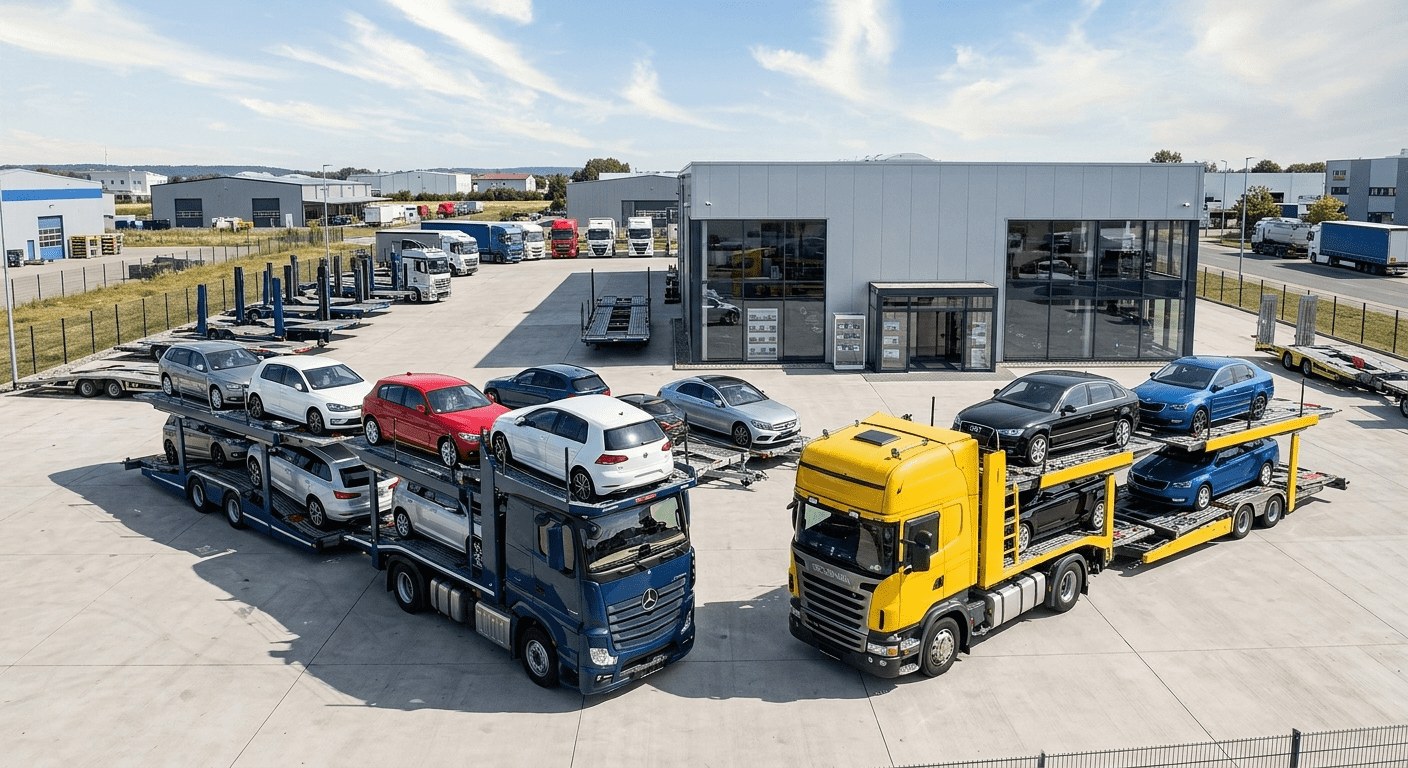
A transfer only creates value when the receiving store sells the vehicle faster and at a higher net return. Moving an aged unit without a deadline often adds transport, recon and another markdown.
Category: Business Trends / Group Operations
Target keyword: dealer group inventory transfer
By: DealershipNews.com Editorial Team
We moved a Civic between three stores in 45 days.
Store A sent it to Store B. Store B sent it to Store C. Store C sent it back to Store A.
Each move triggered another transport charge, condition check and detail:
Recon and condition work: $180
Transport: $90
Detail: $50
Cost per move: $320
Three moves cost:
$320 × 3 = $960
The vehicle was older, more expensive and no closer to a retail sale.
A separate late-transfer review produced the $600 headline. Moving a unit after day 60 created $320 in transfer-related expense and a $400 markdown at the receiving store.
Late-transfer cost:
$320 + $400 = $720
A planned day-30 transfer would have cost about $120 under the group’s direct transport arrangement.
Avoidable difference:
$720 − $120 = $600
The five-store group moved about 140 units each month. There was no central approval process. UCMs sent photos and stock numbers through WhatsApp, then waited for another manager to answer.
These eight rules turned dealer group inventory transfer decisions into a net-return process.
| # | Inventory Transfer Rule | What Happens Without the Rule | Cost Without Rule | Controlled Cost | How the Rule Protects Gross | Deadline |
| 1 | Transfer only while the unit is fresh | Day-75 unit receives transport, recon and another markdown | $720 | $120 planned transport | Avoids $600 in late-transfer expense | Review days 30 to 45, no routine transfer after day 60 |
| 2 | Transfer no more than once | One Civic moves three times and collects repeated costs | $960 | $120 for one planned move | Avoids up to $840 in repeated movement | Second proposed transfer triggers exit review |
| 3 | Receiving store accepts within 24 hours | Vehicle waits without ownership, merchandising or pricing | Five days of carrying cost plus lost traffic | Same-day ownership assignment | Removes idle days from the process | Accept or reject within 24 hours |
| 4 | Cap pre-transfer recon at $300 | Both stores complete overlapping $600 repair orders | $1,200 | Up to $600 combined | Avoids $600 in duplicate recon | Approval required above $300 before transfer |
| 5 | Compare transfer cost with expected hold loss | Store transfers without measuring markdown or carrying cost | $550 or more in expected loss | $120 transport in example | Protects $430 or more | Calculate before approval |
| 6 | Transfer only to a stronger model market | Vehicle moves to another store with the same turn rate | $841 modeled holding and markdown exposure | $120 transport | $721 modeled advantage | Receiving store must show materially faster turn |
| 7 | Reset photos and price on arrival day | Vehicle stays online with old plates, store and price | Three days of weak or missing VDP exposure | Same-day merchandising | Protects traffic and lead opportunity | Complete before close of business |
| 8 | Use one group transfer board | Managers call and message four stores for every unit | About 10 manager hours weekly | Five-minute daily review | Reduces search time and missed matches | Update each morning |
The savings overlap. Do not add every row and call the total savings per vehicle. The group’s $600 result came from comparing its old late-transfer process with a controlled one-transfer process.
#1: Transfer Between Days 30 and 45, Not After Day 60
A transfer works best before the unit becomes an aged problem.
At day 30, the receiving store still has time to merchandise, price and retail the vehicle without inheriting a 75-day unit.
At day 75, the transfer moves age rather than solving it.
The late-transfer example carried these costs:
Transport: $120
Condition work and detail: $200
Receiving-store markdown: $400
Total: $720
A planned early transfer required only the $120 movement cost because the group assigned full merchandising and recon ownership before the vehicle moved.
Difference:
$720 − $120 = $600
Day 30 starts the review. Day 45 closes the normal transfer window. After day 60, the group compares current retail net with wholesale net instead of sending the problem to another rooftop.
A rare unit or a documented customer match might justify an exception. The exception needs a receiving manager, expected sale date and written net calculation.
Action: Put every day-30-to-45 vehicle on the group transfer board. Remove routine transfer as an option after day 60.
#2: One Vehicle Gets One Transfer
The Civic moved from Store A to B, then B to C, then C back to A.
Each manager believed the next store had a better chance.
Nobody checked whether the first transfer improved VDP activity, leads, appointments or market position.
Three transfer cycles cost $960:
$320 × 3 = $960
The controlled process allowed one planned move costing $120. The receiving store accepted retail ownership and committed to a price, photo deadline and exit date.
Modeled difference:
$960 − $120 = $840
A second proposed transfer means the first decision failed. The vehicle needs a retail-versus-wholesale review, not another ride across town.
Add a transfer-count field to the DMS or group sheet:
Zero transfers: eligible
One transfer: no further move
Second request: group UCM approval and exit decision
Action: Tag every transferred VIN. A second transfer request triggers wholesale review.
#3: Accept or Reject the Unit Within 24 Hours
Store A offered a transfer on Monday.
Store B’s UCM saw the message but did not answer until Saturday. The vehicle remained parked with no assigned price, no updated photos and no clear retail owner.
The brief assigned $180 in floorplan cost to those five days. Pure interest does not support that number.
For a $22,000 vehicle at an 8% annual floorplan rate:
$22,000 × 8% ÷ 365 = $4.82 per day
Five days of interest:
$4.82 × 5 = $24.10
A $180 figure would need to include additional carrying expense, depreciation or lost opportunity. Label the amount as total modeled holding cost, not floorplan interest.
Traffic loss is easier to see.
At 35 VDP sessions per day:
35 × 5 = 175 missed or misdirected sessions
The transfer board now requires a response within 24 hours:
Accept
Reject
Request one documented condition item
Silence counts as rejection. The group UCM then offers the vehicle elsewhere or starts the exit process.
Action: Add an acceptance deadline and receiving manager to every transfer request.
#4: Cap Pre-Transfer Recon at $300
Store A completed a $600 repair order before transferring a vehicle.
Store B inspected the same unit and opened another $600 repair order. Some work addressed new needs. Other charges repeated detail, inspection and minor cosmetic work.
Combined recon:
$600 + $600 = $1,200
The new rule caps pre-transfer spending at $300 unless safety, legal or transportation needs require more.
Store A handles only the work needed to move and accurately represent the vehicle. Store B owns retail recon after acceptance, with another $300 target in this example.
Controlled total:
$300 + $300 = $600
Modeled saving:
$1,200 − $600 = $600
A $300 cap will not fit every vehicle. Tires, glass, brakes and warning lights often exceed it. The purpose is approval control, not ignoring safety repairs.
Send the receiving store:
Original inspection
Completed repair order
Open items
Tire and brake measurements
Damage photos
Total recon invested
Action: Require group UCM approval before pre-transfer recon exceeds $300.
#5: Compare Transport Cost With Expected Hold Loss
A $120 transfer looks cheap. A $400 markdown looks expensive.
The comparison still needs the full expected hold cost.
Assume the current store expects:
Required markdown: $400
Another 30 days of carrying and market exposure: $150
Total expected hold loss: $550
The receiving store has stronger demand, and transport costs $120.
Modeled advantage:
$550 − $120 = $430
Use this formula:
Transfer advantage = Expected hold loss at current store − Total transfer cost
Total transfer cost includes transport, added recon, detail, photo work, title movement and lost selling days.
The group approves a move only when:
Expected hold loss exceeds $500
Transfer cost stays below 50% of expected hold loss
Receiving store shows a stronger turn rate
Vehicle remains inside the transfer window
A $400 markdown alone would not meet the group’s $500 threshold. The unit qualifies only after carrying and market exposure push expected loss above $500.
Action: Put the calculation beside every transfer request. Do not approve a move from a photo and one WhatsApp message.
#6: Move the Vehicle Where the Model Sells Faster
Store A averaged 45 days to sell a Civic. Store B averaged 15 days.
The difference was 30 days.
The internal model assigned $14.70 per day to total carrying and market exposure:
30 × $14.70 = $441
Expected markdown at Store A:
$400
Total exposure at Store A:
$441 + $400 = $841
Transfer cost:
$120
Modeled advantage:
$841 − $120 = $721
The $441 amount should not be labeled pure floorplan interest. On a $22,000 balance at 8%, 30 days of interest is about $145. The remaining amount represents other modeled holding costs and market risk.
Build a model-by-store report with:
Units sold
Average days to sale
Front gross
Wholesale exits
VDP sessions
Lead conversion
Current supply
Do not transfer a Civic to Store B because someone says compact cars sell there. Require recent sales data.
Action: Approve the receiving store only when its model-level turn materially beats the current store.
#7: Reset Photos and Price on Arrival Day
The transferred vehicle arrived Monday.
The photos still showed Store A’s plate frame and photo background. The VDP carried Store A’s price. Store B did not replace the content until Thursday.
At 35 VDP sessions per day, three weak merchandising days equal:
35 × 3 = 105 sessions
At a 2% lead rate:
105 × 2% = 2.1 potential leads
Do not automatically call those two leads $400 in lost gross. A lead is not a sale. The store needs its own lead-to-sale rate and gross per sale to calculate expected value.
Using a 20% close rate and $2,200 gross:
2.1 leads × 20% × $2,200 = $924 in modeled gross opportunity
That is a funnel estimate, not a booked loss.
The receiving store must reset:
Price
Store location
Photos where needed
Description
Tracking number
CTA routing
Inventory feed destination
Action: Complete the price and merchandising reset before the vehicle appears as available at the receiving store.
#8: Replace WhatsApp Chaos With One Group Board
Before the rules, the transfer process lived inside separate message threads.
A UCM photographed a stock number, sent it to four managers and waited. Replies arrived hours later. Another manager asked for mileage already listed in the DMS.
The group estimated about ten manager hours a week went into calls, messages and repeated follow-up.
The new board takes five minutes each morning.
Required columns:
VIN and stock number
Current store
Days in inventory
Cost and retail price
Recon invested
Best wholesale net
Model turn by rooftop
Transfer cost
Receiving store
Acceptance deadline
Transfer count
Final decision
WhatsApp still works for alerts. It no longer acts as the system of record.
Action: Review all day-30-to-60 units on one shared board during the Monday group meeting.
Group Math: 140 Transfers at $600 Equals $84,000 a Month
Monthly transfer volume:
140 units
Average modeled improvement:
$600 per transferred unit
Monthly value:
140 × $600 = $84,000
Annualized value:
$84,000 × 12 = $1,008,000
The annual figure assumes every one of the 140 transfers improves by $600. Your controller should verify the result through actual before-and-after net proceeds.
Track:
Old-store expected retail net
Transfer cost
Receiving-store recon
Final selling price
Days after transfer
Final front gross
Wholesale alternative on transfer date
A transfer does not save money because the vehicle moved. It saves money only when the receiving store produces a better net result before another markdown or curtailment.
Related: 6 Wholesale Exit Rules That Recover $700 per Aged Unit
Related: The $100K Mistake: Holding Aged Units Past 90 Days
Sponsored by Gas.net — powering dealership growth through intelligent data.
Alt text: “Gas.net connects franchise dealers with integrated analytics and marketing tools.”