
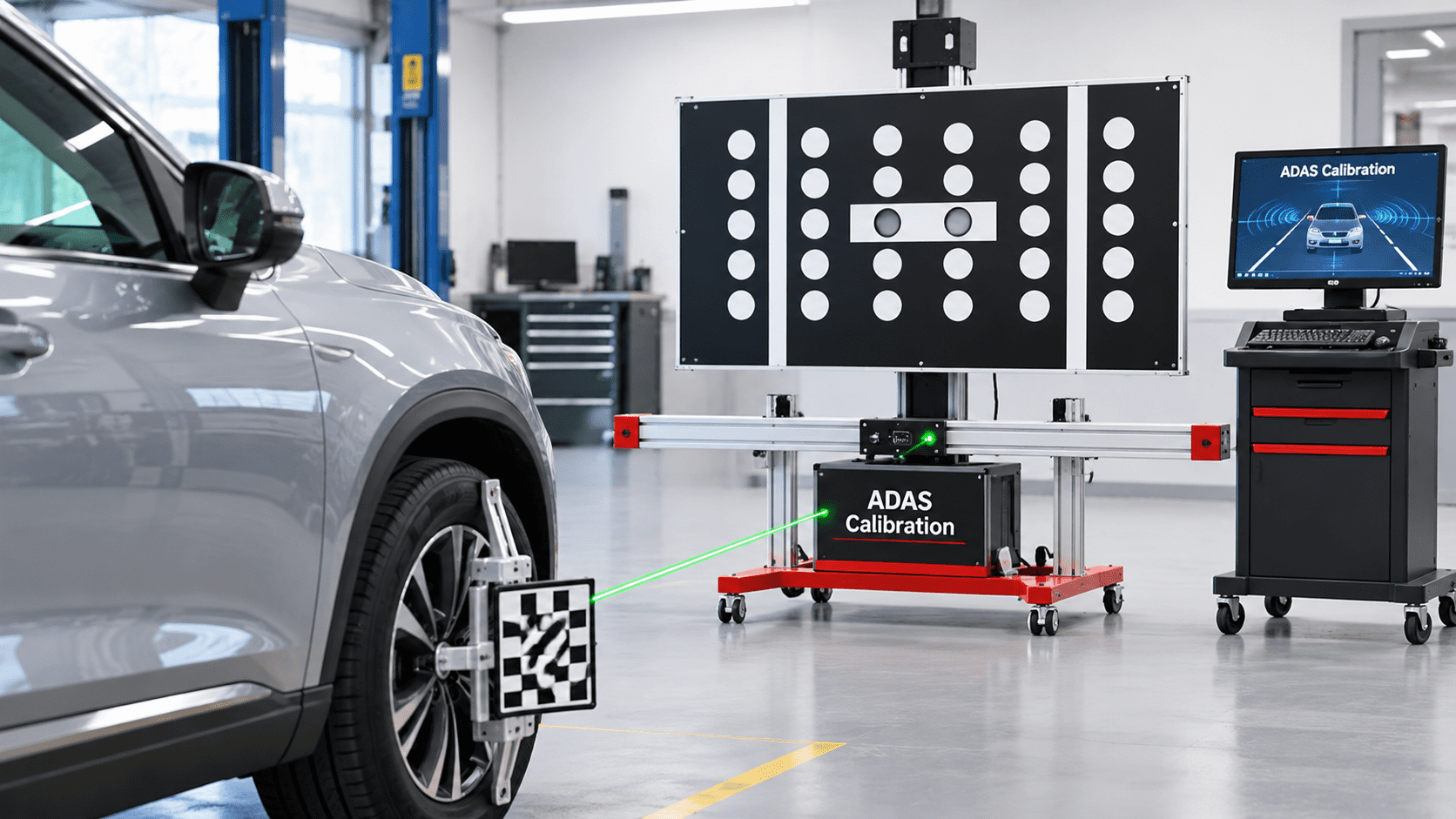
A vendor proposed $180,000 in autonomous vehicle dealer service equipment. The pitch was simple: buy the full package now or lose every ADAS job to a competitor.
Our 90-day audit across four service departments found a different answer. ADAS calibration demand averaged 12 jobs a week at the representative store, or 48 a month. A full autonomous-vehicle bay had almost no current workload.
We approved an $80,000 near-term purchase order and deferred $100,000 from the packaged proposal.
| # | Service Investment | Standalone Quote | Decision | Current Demand per Store | Payback Estimate | Risk From Buying Now | Risk From Waiting |
| 1 | ADAS calibration rig and targets | $45,000 | Buy now | 48 calibrations monthly | About 6 months | Low if procedures match vehicle mix | High, 48 jobs leave the store |
| 2 | ADAS training for two technicians | $8,000 | Buy now | Supports 48 calibrations monthly | About 2 months from avoided sublet and rework | Low, skill stays with store | High, equipment remains unused |
| 3 | Diagnostic scanner with current ADAS software | $12,000 | Buy now | 60 scans monthly | About 4 months | Low with supported makes and updates | Medium, missed codes and sublet work |
| 4 | Dedicated lidar cleaning and sensor bay | $35,000 | Wait and review in 2027 | 2 jobs monthly | About 36 months | High, bay and equipment sit idle | Low, sublet two jobs |
| 5 | Full AV lift and alignment bay | $55,000 | Wait and review in 2027 | 1 specialized job monthly | About 60 months | High, $55,000 tied up | Low at current volume |
| 6 | High-voltage battery tools | $25,000 | Wait unless EV repair mix supports purchase | 3 jobs monthly | About 24 months | Medium if EV repair demand stays low | Low below case-study threshold |
| Total | Six quoted investments | $180,000 | Buy $65,000 in equipment, add approved setup, defer package balance | Current demand centers on ADAS | Verify with gross contribution | Up to $100,000 deferred | Preserve current calibration work |
The line-item quotes total $180,000: $65,000 marked buy and $115,000 marked wait. Adding $15,000 in installation to those figures would create a $195,000 all-in proposal.
The supplied $100,000 saving works only when the $15,000 setup amount already sits inside the vendor’s $180,000 package through installation, overlap or package allocation. The final purchase order must show $80,000 approved and $100,000 deferred. Without this structure, the deferred standalone equipment equals $115,000.
ADAS is the current autonomous vehicle dealer service opportunity
Most work in the audit involved advanced driver assistance systems, not vehicles operating without a driver.
NHTSA distinguishes Level 2 driver assistance from automated driving systems. With Level 2, the driver remains responsible and must monitor the road even when the system assists with steering, acceleration and braking. NHTSA
Use the right language in your capital request:
- ADAS calibration
- Camera aiming
- Radar alignment
- Pre-repair and post-repair scans
- Steering-angle or sensor initialization
- Static and dynamic calibration
Calling every camera or radar repair “autonomous vehicle service” inflates demand. It also gives a vendor room to bundle equipment for work your store does not perform.
Build the decision from repair orders. Count windshield replacements, collision repairs, alignments, bumper work, sensor removal and warning-light diagnoses requiring calibration under OEM procedures.
I-CAR notes calibration events and tools differ by automaker, model and model year. Its guidance directs repairers to follow current vehicle-maker procedures rather than a generic calibration assumption. rts.i-car.com
#1 and #2: Buy the ADAS rig and technician training together
The store completed or sublet 48 ADAS calibrations a month. This was current demand, not a forecast built from future vehicle sales.
The $45,000 rig included the target system and core hardware needed for the store’s most common makes. Before signing, the service director checked target coverage against the prior 90 days of VINs.
Do not buy a rig from a brand list alone. Ask the vendor to demonstrate the following on vehicles your store services:
- Target setup and measurement
- Static calibration
- Dynamic calibration
- Radar aiming
- Camera calibration
- Pre-scan and post-scan
- Result documentation
- Software update process
The vendor projected a six-month payback. At $200 in calibration revenue, 48 monthly jobs produce $9,600 in revenue.
A six-month payback on $45,000 requires $7,500 in monthly gross contribution. Revenue does not equal contribution. Subtract technician labor, subscriptions, target replacements, maintenance, floor space and failed-calibration time before accepting the six-month claim.
Training belonged on the same purchase order. A $45,000 rig without trained technicians becomes storage equipment.
We budgeted $8,000 for two technicians. Both completed hands-on instruction, documented practice calibrations and learned when to stop and consult the OEM procedure.
I-CAR says some calibrations require specific workspace conditions, vehicle preparation, special tools or a road procedure. Requirements differ even within one automaker. icarfmtest.rts.i-car.com
Track training by technician, course, vehicle system, completion date and observed calibration. A course certificate does not replace supervised practice.
Action: Buy the rig only after verifying vehicle coverage, workspace requirements and technician readiness.
#3: Buy the scanner, but audit subscriptions first
The $12,000 scanner package supported 60 scans a month. Technicians used it for ADAS faults, module communication, calibration setup and post-repair verification.
This equipment had broader use than the dedicated calibration rig. It supported customer-pay diagnosis, collision work, windshield jobs and warning-light complaints.
The quote included first-year software access. Years two and three carried renewal fees, so the CFO added those costs to the payback sheet.
Ask five questions before approval:
- Which makes and model years receive full ADAS support?
- Does the tool perform calibration functions or only read codes?
- What OEM subscriptions remain separate?
- How much do annual updates cost?
- What documentation does the tool store with the repair order?
One manufacturer bulletin hosted by NHTSA shows a lane-departure warning after windshield replacement or service work tied to missing calibration, incorrect mounting or module faults. The repair procedure includes inspection, scan-tool diagnostics and calibration steps before component replacement. static.nhtsa.gov
A scanner does not replace the service manual. It gives the technician access to the procedure and system data needed to follow the correct repair path.
Action: Buy the scanner after calculating three years of software, OEM access and support costs.
#4 and #5: Wait on the lidar bay and full AV alignment bay
The $35,000 lidar cleaning and sensor-bay proposal supported two current jobs a month. At this volume, the bay would remain empty for most of the schedule.
We deferred the purchase and built a sublet process:
- Approved outside provider
- Written estimate
- Transport responsibility
- Calibration report attached to the RO
- Post-service verification
- Customer completion time
- Monthly sublet cost
Two monthly jobs provide enough data for a later decision. Review the purchase when the trailing 90-day average reaches the volume needed for your required payback.
The $55,000 full AV lift and alignment bay had even less support. The audit found one qualifying job a month.
A specialized bay also consumes floor space. The ROI sheet should include displaced customer-pay work, electrical upgrades, floor preparation, maintenance and technician training.
We set a 2027 review date rather than rejecting the equipment forever. The decision changes when monthly sublet cost, wait time and lost jobs exceed ownership cost.
Action: Sublet low-volume work and retain every invoice, cycle-time delay and declined job in the review file.
#6: High-voltage tools follow EV repair demand, not AV claims
High-voltage battery tools belong to EV service planning. They are not proof of autonomous-vehicle service capability.
The $25,000 package supported only three current jobs a month. The store’s EV sales mix did not justify the purchase by itself.
Use repair-order mix instead. Count high-voltage diagnostic, battery, cooling, charging and isolation work requiring the proposed tools.
The case-study threshold was 30% EV share within the relevant service population. It is not a universal benchmark. A store with lower EV share and high battery-repair volume might reach payback sooner.
Before purchasing, include:
- Technician high-voltage training
- Personal protective equipment
- Insulated tools
- Test and recertification schedules
- Battery lifting and storage needs
- Emergency procedures
- OEM tool requirements
- Three-year software and maintenance cost
Action: Buy high-voltage equipment when actual repair demand supports the payback, not when a vendor groups EV and autonomous technology into one proposal.
Capital math: Approve $80,000 and hold $100,000
The accepted near-term plan was:
ADAS rig and targets: $45,000
Training for two technicians: $8,000
Diagnostic scanner and software: $12,000
Approved installation and setup allocation: $15,000
Near-term purchase order: $80,000
Vendor package: $180,000
Approved now: $80,000
Deferred package amount: $100,000
At 48 calibrations a month and $200 revenue per calibration:
48 × $200 = $9,600 monthly revenue
$80,000 ÷ $9,600 = 8.3 months on a simple revenue basis
A true payback calculation uses gross contribution:
Monthly calibration revenue
Minus technician labor
Minus software and OEM access
Minus equipment maintenance
Minus facility cost
Minus rework and failed calibrations
Equals monthly gross contribution
If monthly contribution equals $6,500, the $80,000 plan takes about 12.3 months to repay. Put both revenue payback and contribution payback on the vendor decision sheet.
Your capital board should show quoted cost, current monthly jobs, labor hours, revenue, contribution, sublet expense, workspace needs, training status and review date.
Related: 7 Predictive Lead Scores That Help BDC Contact Buyers 30 Minutes Faster
Sponsored by Gas.net — powering dealership growth through intelligent data.
Alt text: “Gas.net connects franchise dealers with integrated analytics and marketing tools.”