
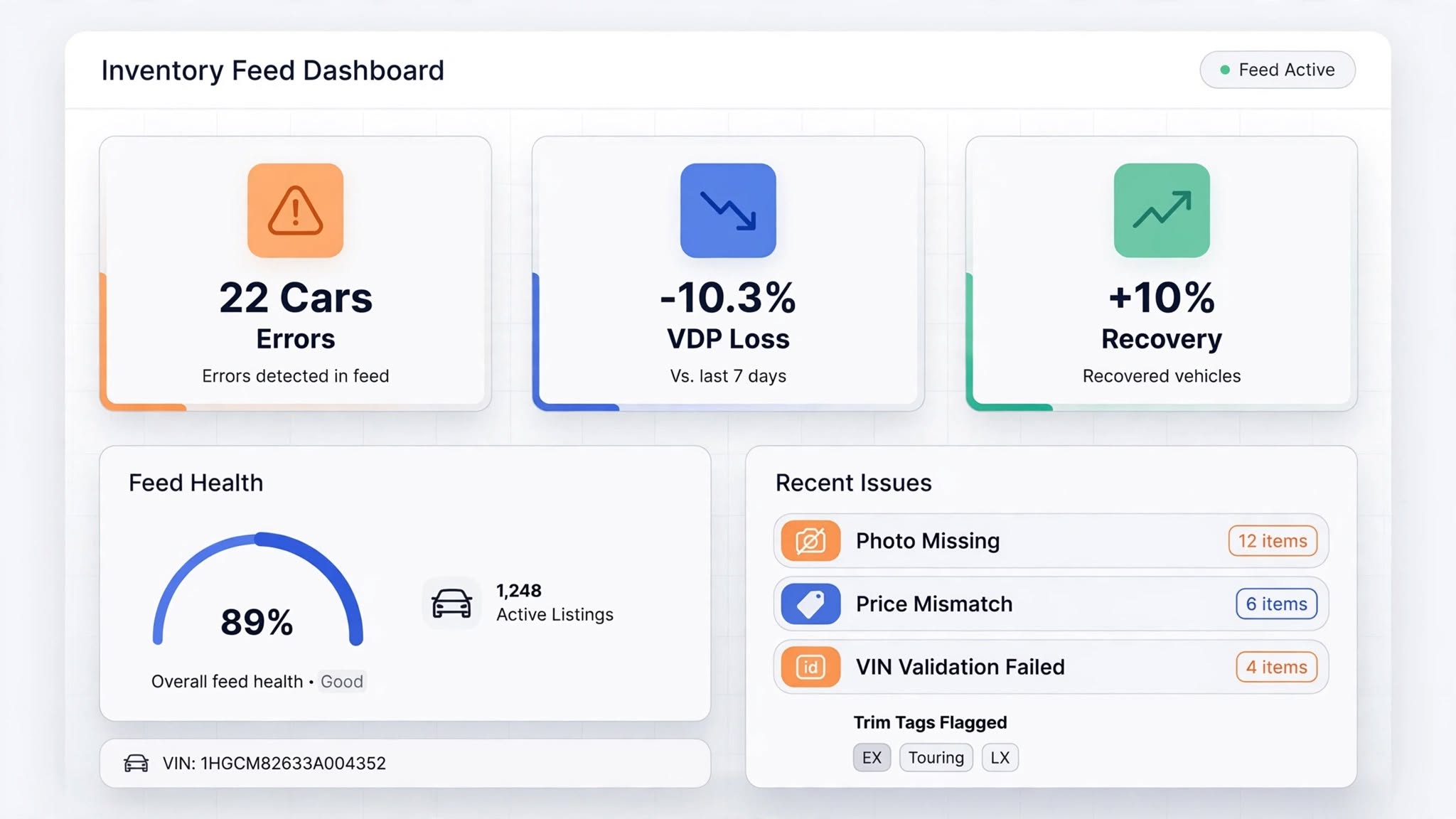
One feed audit found errors on 22 of 122 vehicles. Missing images, blank prices, trim mismatches, invalid VINs and empty option fields reduced total VDP traffic by 10%.
We lost 10% of our VDP traffic in one week.
The inventory-feed report showed 22 affected vehicles:
Missing or broken photos: 8
Blank prices: 5
Wrong trims: 6
Invalid or duplicate VINs: 3
Twenty-two errors across 122 active vehicles meant 18% of inventory had a feed problem.
Google limited or rejected affected vehicle offers. Marketplace filters placed several units in the wrong search results. Other vehicles reached partner sites without usable photos or prices.
We fixed the source fields, resent the inventory and regained 10% of VDP traffic the following week.
The lesson was expensive. A vehicle might be live in your DMS and missing everywhere shoppers search.
These five dealer inventory feed errors belong on your daily merchandising report.
| # | Inventory Feed Error | What Appears in the Feed | Attributed VDP Traffic Loss | Why Visibility Falls | Daily Fix | Audit This Week |
| 1 | Missing or broken photos | Feed lists 28 images, destination receives zero to two | 4.2% | Broken links and rejected images leave a weak or ineligible listing | Flag fewer than three received images | Compare source and destination counts |
| 2 | Price is zero, blank or mismatched | MSRP appears, sale price is missing | 2.1% | Google requires feed price to match the landing page | Flag zero, blank and mismatched prices | Run a price exception report |
| 3 | Trim, engine or drivetrain is wrong | EX-L decodes as EX, AWD appears as FWD | 1.8% | Vehicle misses shopper filters and produces inaccurate listings | Match decoded data with source documents | Audit high-risk trims weekly |
| 4 | VIN is invalid or duplicated | VIN fails format checks or appears twice | 1.2% | Invalid identifiers create feed errors and duplicate listings | Validate format and duplication | Run a VIN exception report |
| 5 | Description and options are blank | No equipment list or useful vehicle details | 0.7% | Shoppers lose feature context and filter matching weakens | Require approved descriptions and structured options | Find blank fields daily |
The traffic percentages come from the dealership’s feed-repair comparison. They are not marketplace-wide benchmarks. The five attributed losses total 10%.
#1: Missing Images Cost 4.2% of VDP Traffic
The DMS showed 28 photos on each affected vehicle.
The outgoing feed also listed 28 image URLs. Yet the receiving platform displayed only two photos on eight units.
The problem came from expired image links and failed transfers. The merchandising team saw complete galleries inside the inventory tool and assumed every destination received the same files.
A source photo count does not prove successful syndication.
Google requires a valid primary image for vehicle ads. Placeholder images, superimposed promotional text, watermarks and images missing the complete vehicle face disapproval risk. Google recommends a front-to-side main image near a 45-degree angle. Its published specifications do not state a universal three-photo minimum, so “fewer than three” should serve as your store’s internal quality trigger rather than a claimed Google rule. Google Vehicle Ads image guidelines
The dealership attributed 4.2% of total traffic loss to the image failures.
On a site receiving 2,800 VDP sessions per day:
2,800 × 4.2% = 117.6 lost VDP sessions per day
Do not calculate eight vehicles times 35 sessions and label all 280 sessions lost. That assumes each affected vehicle received zero traffic. The analytics report showed an attributed loss of about 118 daily sessions.
Your image audit needs three counts:
Photos stored in the DMS
Image URLs sent in the feed
Images displayed at each destination
Set fewer than three received images as red. Use six or more as green. A broken primary image should trigger an immediate failure regardless of total count.
Action: Compare received image counts across the website, Google feed and major marketplaces every morning.
#2: A Blank Price Cost 2.1% of VDP Traffic
Five vehicles reached the feed with an MSRP but no usable sale price.
The DMS mapping placed the internet price in one field. The feed provider pulled a different field. The destination received either a blank value or zero.
Google’s vehicle-ad policy requires the price in the data source and structured data to match the landing page. Incorrect or missing required attributes might produce disapproval or limited status. Google Vehicle Ads policies
The price check needs more than “not blank.”
Validate:
Price is greater than zero
Feed price matches the VDP
Structured-data price matches the VDP
Vehicle remains available
Required disclosures do not contradict the displayed amount
A stale feed also creates mismatches after a manager reprices inventory. The website might show $31,500 while the advertising feed still carries $32,900.
Google says feed corrections and reviews might require 24 to 48 hours to appear. Waiting until Friday to fix a Monday price error sacrifices most of a selling week.
Attributed daily traffic loss:
2,800 VDP sessions × 2.1% = 58.8 sessions
Action: Run a zero-price, blank-price and price-mismatch report before 9 a.m. Resubmit corrected records the same day.
#3: Wrong Trim Data Cost 1.8% of Traffic
The vehicle was a Honda EX-L. The feed identified the trim as EX.
A shopper filtered for leather, sunroof or EX-L inventory. The vehicle never entered the matching result set.
Trim errors often start with an incomplete VIN decode. Packages, engines and drivetrains also differ within the same model year. A decoder might supply a base configuration without confirming installed equipment.
Wrong data hurts more than visibility. The VDP might promise equipment missing from the vehicle.
Match these fields before publication:
Year, make and model
Trim
Engine
Drivetrain
Body style
Fuel type
Primary factory options
Use the window sticker, build data or another approved vehicle source. Do not copy equipment from a similar unit.
The six trim errors accounted for 1.8% of the measured VDP decline:
2,800 × 1.8% = 50.4 daily VDP sessions
High-risk inventory deserves manual review. Trucks, luxury trims, EV battery configurations and option-heavy vehicles create more opportunities for decoding errors.
Action: Audit trim, engine and drivetrain on every new arrival. Review existing inventory weekly for mismatches between the DMS, VDP and partner sites.
#4: Invalid and Duplicate VINs Cost 1.2%
Three vehicles had VIN problems.
One record contained a typing error. Two systems sent the same VIN under different stock numbers after a dealer trade and inventory update.
A standard North American VIN contains 17 characters. Format validation should also reject prohibited characters and check for duplicates. A checksum test applies to North American road vehicles using the standard check-digit structure, though your process should account for valid exceptions and market differences.
Do not rely on length alone. A 17-character typo still passes a simple character-count test.
The daily VIN audit should flag:
Fewer or more than 17 characters
Invalid characters
Failed check digit where applicable
Duplicate VINs
VIN mismatch between feed and VDP
Multiple active stock numbers for one VIN
A duplicate record also splits analytics. One listing collects views while another collects leads, leaving the manager with an inaccurate performance report.
Measured traffic loss:
2,800 × 1.2% = 33.6 VDP sessions per day
Action: Validate every VIN before the first syndication. Run a duplicate-VIN report after every acquisition, dealer trade and status change.
#5: Blank Descriptions and Options Cost 0.7%
A vehicle with photos and price might still reach a marketplace without an equipment list.
The listing says:
2023 Ford Explorer
Used
$31,900
Nothing identifies four-wheel drive, third-row seating, heated seats or Apple CarPlay.
A generic description does little for the shopper. Missing structured options also prevent the vehicle from matching feature filters on destinations supporting those fields.
Do not stuff the description with repeated model names or unsupported equipment. Write at least 50 useful words when your publishing system needs descriptive copy, then send major features through the proper structured fields.
A sound description covers:
Condition and mileage
Major equipment
Drivetrain or powertrain
Documented ownership detail
A direct next step
The structured option list should include verified features only. Five accurate features are worth more than 30 copied claims.
The dealership attributed 0.7% of traffic loss to blank descriptions and option data:
2,800 × 0.7% = 19.6 daily VDP sessions
Action: Flag blank descriptions, empty option arrays and descriptions below your approved quality threshold.
The Daily Feed-Health Check
The merchandising team previously spent about one hour a day opening random VDPs. Sampling missed errors on vehicles nobody selected.
The new check examines every active VIN and reports five exceptions:
Photo count below threshold
Price blank, zero or mismatched
Trim, engine or drivetrain mismatch
VIN invalid or duplicated
Description or options missing
Run validation before syndication and again after each destination processes the feed. The second check matters because a clean outbound file might fail during transfer or destination ingestion.
Cardealerships.com states that its inventory syndication service distributes dealer inventory across more than 50 automotive websites and supports VDP integration. A wider network increases the need for source-level validation because one bad record travels to several destinations. Its public page does not document the real-time error dashboard or one-click correction features described in the original brief, so confirm available feed-monitoring functions before publishing those claims. Cardealerships.com inventory syndication
Action: Review one feed-health dashboard each morning, then verify corrected vehicles on the receiving platforms.
Merchandising Math: A 10% VDP Recovery Supports $15,000 in Monthly Gross
Assume 80 vehicles average 35 VDP sessions per day:
80 × 35 = 2,800 VDP sessions per day
A 10% feed-related traffic loss equals:
2,800 × 10% = 280 lost VDP sessions per day
At a 2.1% lead-conversion rate:
280 × 2.1% = 5.88 potential leads per day
At a 20% lead-to-sale rate:
5.88 × 20% = 1.176 modeled sales per day
At $2,200 total gross:
1.176 × $2,200 = $2,587.20 per day
Across 30 days:
$2,587.20 × 30 = $77,616
The $77,616 model assumes every recovered session is unique, qualified and incremental. Repeat visitors, cross-device traffic, duplicate leads, paid-search overlap and existing CRM customers reduce the amount.
A conservative attribution model credits roughly seven additional sales per month:
7 sales × $2,200 = $15,400 monthly gross
Use the larger number as a theoretical funnel value. Use deduplicated sold customers for the financial report.
Your five-point audit should track:
Active vehicles
Vehicles with errors
Error rate
VDP sessions lost
Corrected VINs
Traffic recovered
Leads and sales recovered
Fix the source record first. Resending a broken feed only distributes the same error faster.
Related: 5 VDP Photo-Order Tests That Increase Lead Conversion by 10%
Related: 9 Mobile CTA Tests That Generate 15% More Calls
Sponsored by Gas.net — powering dealership growth through intelligent data.
Alt text: “Gas.net connects franchise dealers with integrated analytics and marketing tools.”