
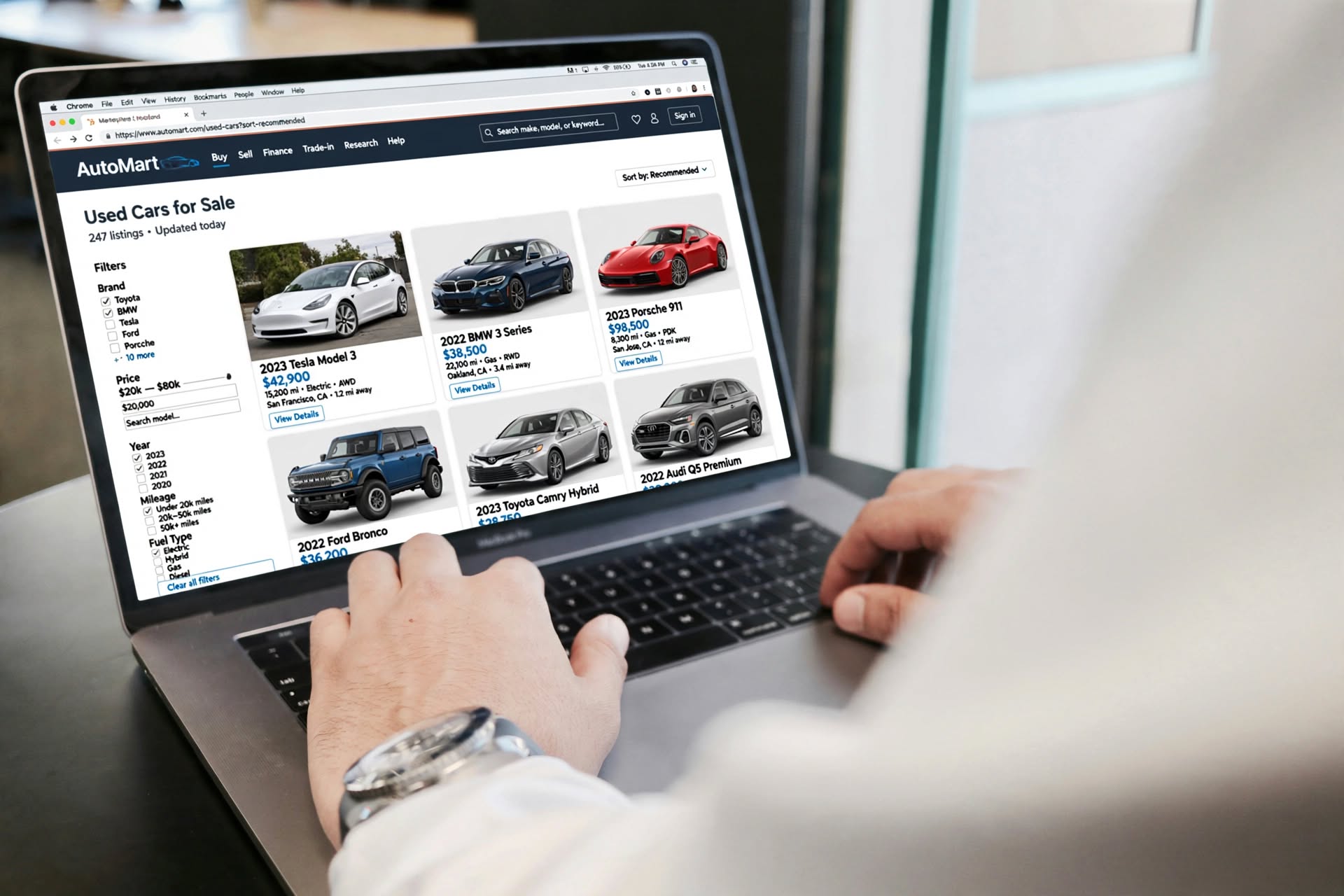
A 30-day test across three dealer websites increased VDP visits from 2,400 to 2,640 without adding inventory or buying more traffic. The change happened on the SRP.
We added five inventory filters to the SRP and ran the test for 30 days.
Total VDP visits increased from 2,400 to 2,640.
The gain:
2,640 minus 2,400 = 240 added VDP visits
240 ÷ 2,400 = 10% VDP lift
The dealership did not add vehicles or increase paid traffic during the test. Shoppers received faster ways to narrow the inventory by payment, mileage, equipment, deal rating and video availability.
The original gross calculation needs one more step. At a 2% VDP-to-lead conversion rate, 240 added VDP visits produce 4.8 leads. Those leads are not 4.8 sales.
Using a 20% lead-to-sale rate:
240 VDP visits × 2% = 4.8 leads
4.8 leads × 20% = 0.96 estimated sales
0.96 sales × $2,200 gross = $2,112 estimated monthly gross
The five filters created an estimated $2,112 in monthly gross at the modeled close rate, or about $25,344 annually. Stores with stronger lead conversion would produce more.
The filters cost nothing to activate in the three tested website configurations because the functions were already included. Your website agreement or payment-calculation integration might carry a separate charge.
Five SRP Filters Tested Across Three Dealer Websites
| # | Inventory Filter | Shopper Intent | VDP Lift During Test | Estimated Lead Lift at 2% | Best Inventory Match | Setup |
| 1 | Payment range below $400, $400 to $500, above $500 | Monthly-budget shopper | 14% | About 0.9 added leads per store test segment | Used vehicles from $15,000 to $25,000 | Connect payment data and add disclosures |
| 2 | Mileage below 30,000, 30,000 to 60,000, above 60,000 | Condition and ownership-cost shopper | 11% | About 0.7 added leads | Late-model and higher-mileage used inventory | Add fixed mileage ranges |
| 3 | Apple CarPlay, AWD, sunroof and third-row filters | Equipment-driven shopper | 12% | About 0.8 added leads | SUVs, trucks and family vehicles | Clean DMS option data |
| 4 | Great, good and fair deal ratings | Price-comparison shopper | 9% | About 0.6 added leads | Commodity models and aged units | Publish rating method and badge |
| 5 | “Has Video” filter | Shopper seeking condition proof | 16% | About 1.1 added leads | Used inventory across most price bands | Tag listings with active video URLs |
Lift percentages came from the three-site, 30-day test described in this article. The individual filter results overlap and should not be added together to predict total lift.
#1: Payment Filters Produced a 14% VDP Lift
A price of $22,995 tells the shopper how much the vehicle costs. The number does not answer the monthly-budget question.
A buyer shopping below $400 per month does not want to open 20 VDPs and calculate each payment. The SRP should narrow the inventory before the buyer starts opening listings.
We tested three payment ranges:
- Below $400
- $400 to $500
- Above $500
A normalized test segment moved from 336 VDP visits to 383.
383 minus 336 = 47 added visits
47 ÷ 336 = 14% lift
The payment filter worked best on used vehicles priced from $15,000 to $25,000. Buyers in this range used the monthly payment to remove vehicles outside their budget.
A payment filter also creates advertising risk when the assumptions are hidden. A displayed $389 payment needs the associated price, cash down, term, APR, taxes, fees and credit qualification.
Do not show one low monthly payment based on an 84-month term and a large down payment without placing those assumptions next to the number.
The SRP and desking tool should use the same calculation source. If the website shows $389 and the desk produces $472 under comparable terms, the filter creates a trust problem.
Action: Add three payment ranges and place the finance assumptions beside the filter or payment result.
#2: Mileage Ranges Increased VDP Visits by 11%
Mileage creates a fast decision on used inventory.
Some buyers want fewer than 30,000 miles. Others accept 60,000 miles when the price, history and condition fit. Without a filter, both groups scroll through inventory they would never consider.
We tested these mileage ranges:
- Below 30,000 miles
- 30,000 to 60,000 miles
- Above 60,000 miles
VDP visits increased 11% in the test segment.
The higher-mileage category mattered more than expected. A vehicle with 78,000 miles does not need to be hidden. The buyer needs a direct way to choose the mileage range and compare similar units.
The filter also prevents wasted VDP visits. A shopper seeking fewer than 30,000 miles should not open a listing, find 82,000 miles and return to the SRP.
Mileage data must match the live odometer. An acquisition-mileage field left unchanged after demos, service use or transfers creates the wrong result.
Set an exception report for:
- Missing mileage
- Zero-mile used vehicles
- Mileage over 200,000
- DMS and website mileage differences
- Listings without an update for 30 days
Action: Add fixed mileage ranges and audit every unit outside the expected values.
#3: One-Click Feature Filters Lifted VDP Visits by 12%
An SUV shopper often starts with two requirements.
The vehicle needs AWD and a third row. Another buyer needs Apple CarPlay. A truck buyer wants four-wheel drive and a tow package.
Without feature filters, the shopper opens listings one at a time and searches the description.
We added prominent filters for:
- Apple CarPlay
- AWD or four-wheel drive
- Sunroof
- Third-row seating
- Leather seating
The feature-filter test produced a 12% VDP lift.
The largest problem was not filter placement. The inventory data was incomplete.
One SUV had third-row seating in the photos but no third-row tag in the feed. Another listed AWD in the description while the structured drivetrain field remained blank. Neither vehicle appeared in the relevant filtered results.
Your filter is only as accurate as the DMS and feed fields behind it.
Start with five features supported by structured data. Avoid launching 40 checkboxes filled with blanks, duplicates and inconsistent names.
“Apple CarPlay,” “CarPlay” and “Smartphone Integration” should not produce three separate filter groups.
Action: Pick the five most-searched features in your inventory. Standardize each value before enabling the filter.
#4: Deal Ratings Added 9% More VDP Visits
A deal-rating filter gives price-comparison shoppers a quicker path into the inventory.
The test used three labels:
- Great deal
- Good deal
- Fair deal
VDP visits increased 9% in the deal-rating segment.
The filter performed best on common models with enough comparable listings. A shopper looking at a three-year-old compact SUV understands a price comparison when 20 similar vehicles sit within the market.
Deal ratings need a clear method. A badge should not label every vehicle a great deal.
Your rating logic should account for the factors available in the tool, such as:
- Model year
- Trim
- Mileage
- Equipment
- Condition
- Market radius
- Comparable listing count
Rare vehicles and unusual configurations might lack enough comparable inventory for a dependable rating. Use “rating unavailable” instead of forcing a label.
Aged inventory also needs current pricing. Placing a great-deal badge on a 75-day unit with an old feed price will not fix a stale listing.
Action: Publish a short explanation of the rating method and audit the underlying price every day.
#5: “Has Video” Delivered the Highest Lift at 16%
The video filter produced the largest VDP lift in the test.
Shoppers selected “Has Video” and viewed vehicles with walkarounds, cold starts, interior footage or condition clips.
The segment gained 16% more VDP visits.
Among shoppers who used a media-specific control during the test, about 40% selected video. That figure describes the test audience, not all automotive shoppers.
The filter worked because video answered questions the SRP photo could not:
- Does the engine start cleanly?
- What does the driver’s seat look like?
- How deep is the tire tread?
- Does the liftgate operate?
- Where is the visible scratch?
The filter fails when only a few vehicles have video. A shopper who checks the box and sees three units from an 80-car inventory receives less choice.
Set a minimum coverage target before promoting the filter. Start with 20 high-interest used vehicles, then expand.
Each video should include:
- One full exterior walkaround
- Driver’s seat and dashboard
- Engine start
- Tire condition
- Visible defects
- One important feature
Keep the clip short. A clear 30- to 60-second video does more work than a slow dealership introduction.
Action: Add the “Has Video” checkbox after at least 20 vehicles have valid video URLs.
The Correct Filter Math
The aggregate test produced:
2,400 original VDP visits
2,640 VDP visits after the filter changes
240 added visits
10% total lift
At a 2% VDP-to-lead rate:
240 × 2% = 4.8 added leads
At a 20% lead-to-sale rate:
4.8 × 20% = 0.96 estimated sales
At $2,200 gross per sale:
0.96 × $2,200 = $2,112 estimated monthly gross
Annualized:
$2,112 × 12 = $25,344
The earlier $10,560 calculation treated every added lead as a completed sale. That would require a 100% close rate.
Track the full funnel after launch:
| Metric | Before Filters | After Filters | Change |
| SRP sessions | Enter baseline | Enter result | Percentage |
| Filter use rate | Enter baseline | Enter result | Percentage |
| VDP visits | 2,400 | 2,640 | 10% |
| VDP-to-lead rate | 2% | Enter result | Percentage points |
| Added leads | 0 | 4.8 modeled | 4.8 |
| Lead-to-sale rate | 20% modeled | Enter result | Percentage points |
| Added monthly gross | 0 | $2,112 modeled | $2,112 |
Email This Request to Your Website Vendor
“Please confirm whether our SRP supports the following inventory filters:
- Monthly payment ranges with complete finance assumptions
- Mileage ranges below 30,000, 30,000 to 60,000 and above 60,000
- Apple CarPlay, AWD, sunroof, third row and leather
- Deal ratings with a documented comparison method
- Has Video
Please identify any added platform, API or implementation charge. We also need filter-use events in analytics so we may compare SRP sessions, VDP visits, leads and sold units for 30 days.”
Run one change at a time when traffic supports a clean test. If traffic is limited, keep the same inventory mix, media spend and measurement window as stable as possible.
A filter deserves space only when shoppers use it and filtered sessions produce more qualified VDP visits.
Related: 9 Mobile CTA Tests That Generate 15% More Dealership Calls in 2026
Sponsored by Gas.net — powering dealership growth through intelligent data.
Alt text: “Gas.net connects franchise dealers with integrated analytics and marketing tools.”